
Weighted grade calculator: how much does this assignment actually matter?
Sep 25, 2026 · 5 min read
A 5% quiz and a 40% final are not the same problem
You have an assignment due tomorrow.
It is worth 5%.
You also have a project due next week worth 40%.
Your calendar puts the quiz first.
Your grade does not.
This is where a weighted grade calculator becomes useful. Instead of only asking when an assignment is due, you can calculate how much that assignment can actually change your final grade.
That number gives you context.
And context makes it easier to decide where your limited study time should go.
What does “weighted” mean?
A weighted grade means that different assignments contribute different amounts to your final grade.
If your professor says:
Quiz = 10%
Midterm = 25%
Essay = 25%
Final exam = 40%
those percentages aren't just information about the syllabus.
They determine how much each assessment contributes to your final result.
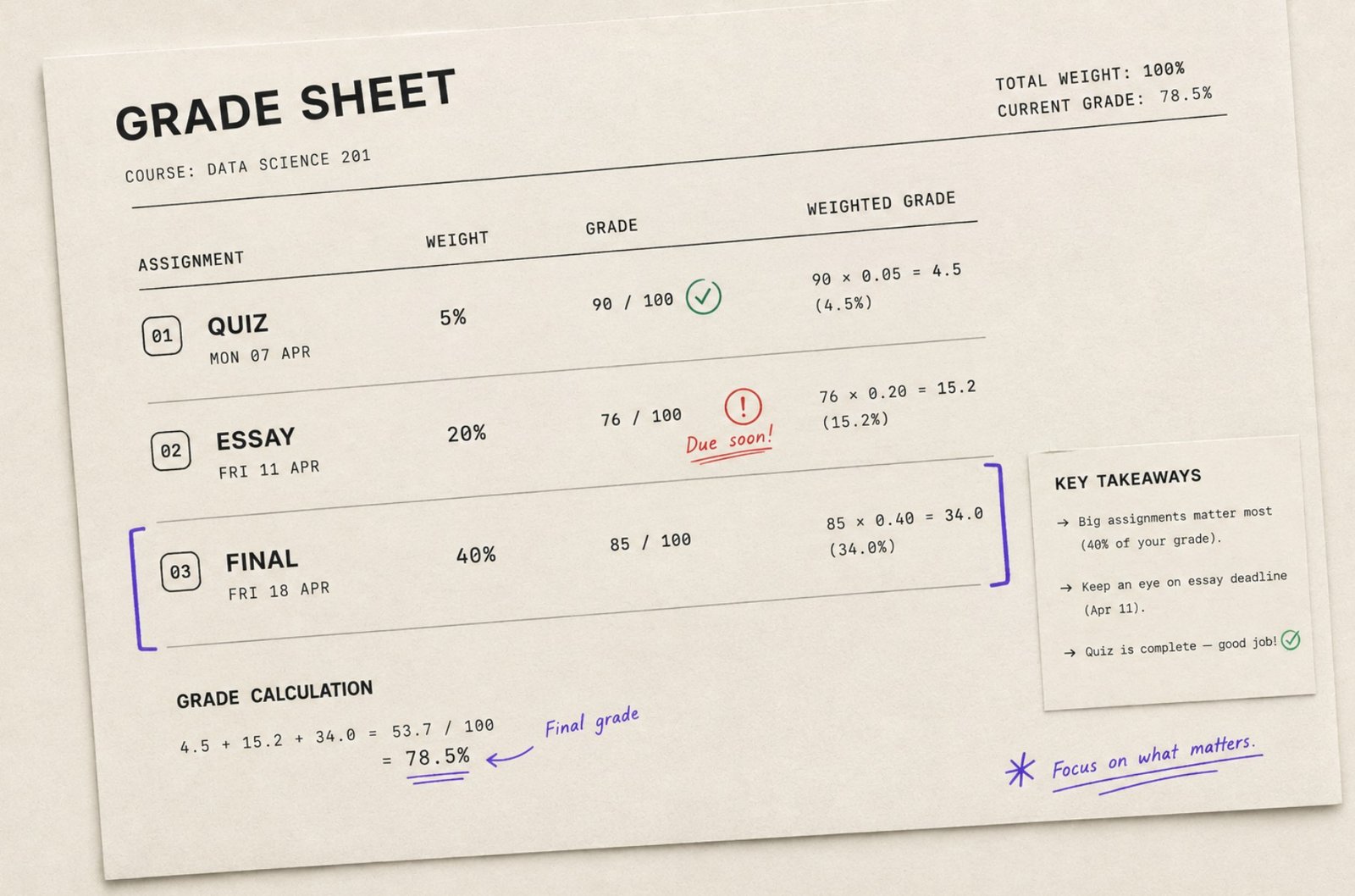
A simple weighted-grade calculation is:
Assignment contribution = your score × assignment weight
For example, if you score 80% on an assignment worth 20% of your final grade:
80 × 0.20 = 16
That assignment contributes 16 percentage points toward your final grade.
If you score 80% on a 5% quiz:
80 × 0.05 = 4
Same score.
Very different impact.
How to calculate your weighted grade
You don't need complicated math.
Take each assignment's score and multiply it by its weight as a decimal.
For example:
Assessment | Score | Weight | Contribution |
|---|---|---|---|
Quiz | 90% | 10% | 9% |
Midterm | 80% | 25% | 20% |
Essay | 85% | 25% | 21.25% |
Final | 90% | 40% | 36% |
Add the contributions:
9 + 20 + 21.25 + 36 = 86.25%
Your weighted course grade would be 86.25%, assuming those are all the components and the weights add up to 100%.
The useful part isn't just calculating the final number.
It's seeing which assignments have enough weight to move that number significantly.
Why assignment weight matters more than the deadline
Let's say you're currently sitting at 82%.
You have two assignments left:
Assignment A: due tomorrow, worth 5%
Assignment B: due next Friday, worth 35%
If you get 100% on Assignment A, it contributes 5 percentage points to the course component.
If you get 100% on Assignment B, it contributes 35 percentage points.
That doesn't mean you should ignore Assignment A.
You still have a deadline.
But it does mean you shouldn't automatically spend four hours perfecting Assignment A while Assignment B hasn't been started.
A deadline tells you when to act.
The weight tells you how much is at stake.
You need both.
How much can one assignment actually change your grade?
Here's a useful shortcut.
If an assignment is worth 10%, improving your score by 10 percentage points changes your overall course grade by 1 percentage point.
If it's worth 40%, the same improvement changes your overall grade by 4 percentage points.
Assignment weight | 10-point improvement changes final grade by |
|---|---|
5% | 0.5 points |
10% | 1 point |
20% | 2 points |
30% | 3 points |
40% | 4 points |
This is why high-weight assignments deserve attention early.
A few extra points on a major project can matter considerably more than squeezing another point out of a tiny quiz.
But what if I already have grades?
This is where a weighted grade calculator gets more interesting.
Suppose your course looks like this:
Homework: 20%
Midterm: 30%
Final exam: 50%
You've already earned:
Homework: 90%
Midterm: 75%
Your current weighted contribution is:
90 × 0.20 = 18
75 × 0.30 = 22.5
So you've earned 40.5 percentage points toward your final grade.
The final exam accounts for the remaining 50%.
If you score 80% on it:
80 × 0.50 = 40
Your final course grade would be:
40.5 + 40 = 80.5%
Now you know exactly what the final can do.
It also tells you something important about where your effort belongs.
Studying for the final can have a much larger effect than obsessing over a homework assignment that represents only a small fraction of the course.
Use grade weight alongside the deadline
This is where the calculation becomes useful for planning.
Don't use grade weight to create a completely separate list from your deadlines.
Combine them.
Imagine your upcoming work looks like this:
Assignment | Deadline | Weight | Current status |
|---|---|---|---|
Quiz | Tomorrow | 5% | Not started |
Lab report | Thursday | 10% | Half done |
Essay | Friday | 25% | Not started |
Final project | Next week | 40% | Not started |
A chronological list says:
Quiz → Lab report → Essay → Final project
A more useful planning view says:
Quiz: finish quickly because it's due tomorrow.
Lab report: complete soon.
Essay: protect enough time because it's worth 25%.
Final project: start now because it's worth 40%, even though its deadline is later.
That's the difference between deadline management and grade-aware planning.
Deadliner uses grade weight as part of its assignment ranking for exactly this reason: the next deadline isn't always the most important thing on your list.
Don't use the calculator as an excuse to ignore small assignments
There is one important catch.
A 5% assignment still matters.
If you're trying to maintain a high grade, losing easy points can add up.
The point isn't:
“Only work on assignments worth 20% or more.”
The point is:
Match the amount of effort to the assignment's actual impact.
A 5% quiz that takes 20 minutes? Do it.
A 5% assignment that is consuming three hours of your life because you've rewritten the introduction six times? Probably stop.
A 40% paper that you've been avoiding because it's “not due yet”? Start it.
The weight gives you a rational way to make those decisions.
A simple weighted-grade system for your syllabus
You can do this with a spreadsheet, calculator, or even a piece of paper.
For every assessment, record:
1. Grade weight
How much is it worth?
2. Deadline
When is it due?
3. Current score
What have you earned so far, if it's already graded?
4. Estimated effort
How long will it realistically take?
Then look for assignments that combine:
High grade weight
A close deadline
High effort
Low progress
Those are your danger zones.
They're the assignments most likely to create a late-night problem.
What to do today
Open your syllabus and list every remaining assessment.
Next to each one, write:
WEIGHT · DEADLINE · ESTIMATED HOURS
Then calculate how much each assignment contributes to the course.
You don't need to obsess over the exact decimal.
You're looking for perspective.
If your list contains:
QUIZ · 5% · TOMORROW · 30 MIN
and
FINAL PROJECT · 40% · NEXT WEEK · 10 HRS
you now have enough information to plan intelligently.
Finish the quiz.
Then start the project.
The calendar tells you what is next.
The weighted grade tells you what is worth protecting.
Deadliner ranks your assignments by what they're actually worth. Try it free